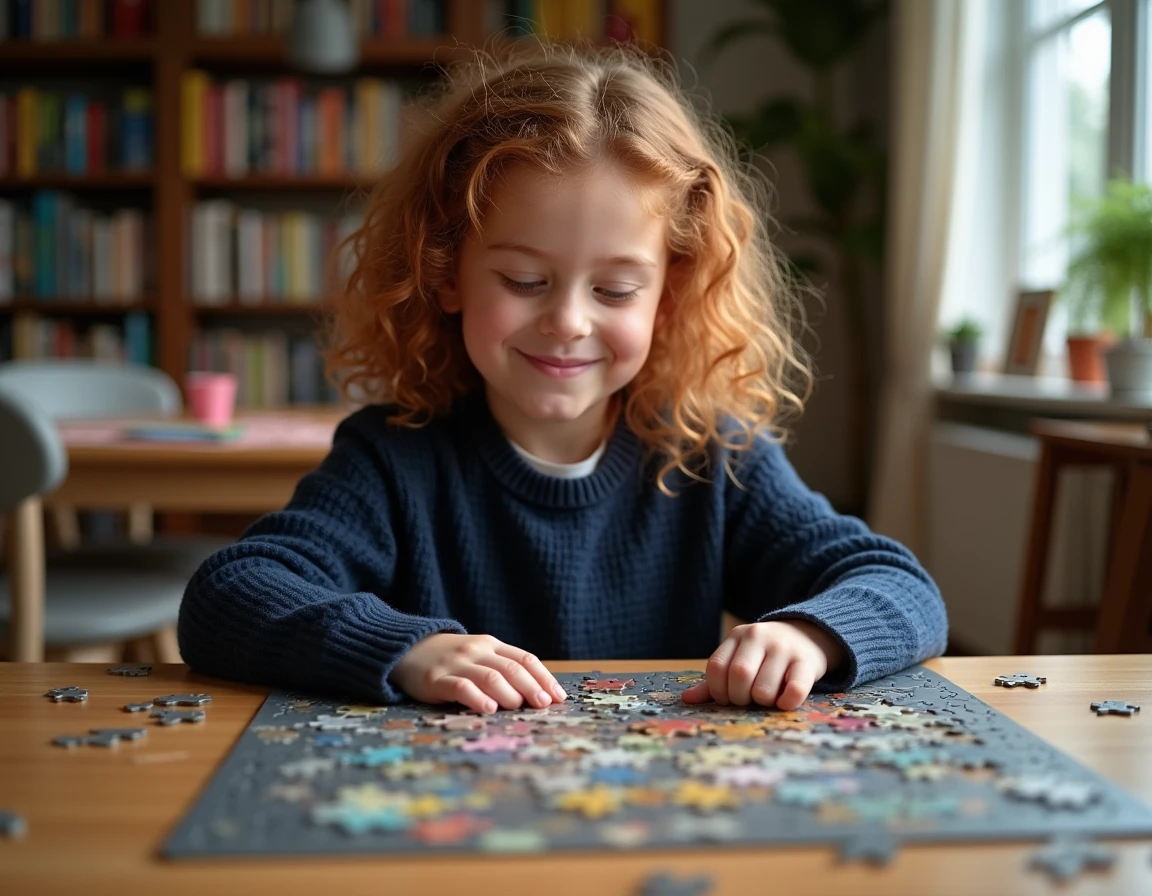
A child who quickly assembles puzzles intended for an older age group attracts attention. Does this ease with puzzles indicate a high overall intellectual potential, or rather a targeted visual-spatial talent? The distinction radically changes the way to support the child on a daily basis.
Visual-spatial skills and puzzles: what performance really measures
Recent work in cognitive psychology establishes that a high level in puzzle and mental rotation tasks is mainly correlated with high visual-spatial skills: mental imagery, object rotation, shape perception. This correlation does not automatically predict a high overall intellectual potential.
The nuance matters for parents. A child who excels at puzzles engages a specific cognitive register, not necessarily all the abilities assessed by an IQ test. Researchers now distinguish between “specific talents” (puzzles, LEGO, geometry) and broader HPI profiles.
Before concluding a giftedness, it is essential to observe whether this ease extends to other areas: early language, verbal logical reasoning, unusual working memory. To stimulate the potential of a gifted child, identifying the exact nature of their abilities remains the first step.
Puzzle and high potential: comparative table of observable indicators
To help parents distinguish a specific talent from a broader HPI profile, here are the most frequently noted indicators from clinical and educational observations.
| Indicator | Targeted visual-spatial talent | Global HPI profile |
|---|---|---|
| Age of solving puzzles | Solves puzzles from an older age group | Same advance, combined with other precocities |
| Assembly strategy | Identifies shapes and colors above all | Verbalizes their strategy, anticipates several steps |
| Transfer to other areas | LEGO, drawing, geometry | Language, early reading, abstract reasoning |
| Reaction to boredom | Seeks more complex puzzles | Gets bored in many school situations |
| Social interactions | Normative sociability | Frequent mismatch with same-age peers |
This table does not replace a professional evaluation, but it helps to identify whether the signals focus on a single register or extend well beyond puzzles.
Risks of over-interpreting puzzle talent
Attributing global giftedness to a child based solely on their puzzle performance carries a concrete risk. Parents then direct stimulation towards an already mastered area, to the detriment of other skills.
Practitioners recommend diversifying stimulation: symbolic play, motor activities, social interactions, language. A child who confines themselves to a domain of excellence may see their development become less harmonious.
- Symbolic play (costumes, invented scenarios) engages narrative imagination, often underdeveloped in highly visual-spatial profiles.
- Sports and motor activities enhance coordination and provide a channel for emotional management distinct from reasoning.
- Cooperative board games require negotiation, waiting for one’s turn, and verbalizing strategies, social skills that can sometimes be fragile in gifted children.
The goal is not to stifle talent, but to avoid asymmetric development where the child excels in one area and falls behind in others.
When to consult a professional
If a child consistently solves puzzles designed for children several years older, while also displaying very advanced language, intense curiosity about various subjects, and social mismatch with peers, a psychometric evaluation may clarify the profile. Standard tests measure several dimensions (verbal, perceptual, working memory, processing speed), allowing for the distinction between an isolated talent and a global high potential.
Adapting puzzle complexity according to the child’s age and profile
Consistently offering puzzles that are too easy to a gifted child generates boredom, even disinterest. Conversely, an excessively difficult puzzle can lead to frustration and quick abandonment.
The right level is just above the comfort zone: the child should be able to complete the puzzle with sustained effort, without constant external help. A few practical guidelines help calibrate progression.
- Increase the number of pieces in stages (move from age-appropriate puzzles to the next age group, not two age groups at once).
- Vary the types of puzzles: 3D puzzles, tangrams, mechanical puzzles. Each format engages different visual-spatial skills.
- Integrate puzzles into cross-disciplinary learning: geographical puzzles for world knowledge, anatomical puzzles for science, geometric pattern puzzles for mathematics.
- Observe the speed of resolution and the degree of concentration. A child who finishes too quickly without visible effort needs an additional challenge.
Research programs in Europe and North America are testing the use of these tools as cross-disciplinary learning supports (mathematics, geometry, science, programming) and as a means to identify high potential students not detected by standard tests.
Puzzles in school: an underutilized identification tool
In school settings, puzzles often remain confined to the play corner of kindergarten. Their potential as a tool for identifying high visual-spatial potential profiles is little exploited by teachers.
A child who stands out significantly from their peers in this type of activity deserves special attention, not to categorize them, but to adapt educational proposals. Puzzles can serve as an early warning signal even before other indicators (academic results, classroom behavior) become visible.
The challenge for parents and teachers remains the same: not to confuse a passing interest with real aptitude. A child who goes through a phase of interest in puzzles is not necessarily a gifted child. The discriminating criterion lies in the duration of interest, the spontaneous progression to higher levels of complexity, and the ability to transfer acquired skills to other cognitive activities.
Performance in puzzles constitutes an indicator among others, never a diagnosis. Observing, diversifying proposed activities, and consulting if signals converge remains the most reliable approach to support a gifted child without projecting disproportionate expectations onto them.